


Page 91 - Real_Reading_1
P. 91
Using  a dictionary   .:t:.,,!_,.Endfu:G


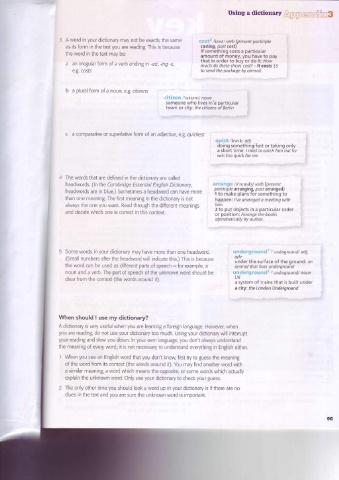
                        A word in your  dictionary may  not be  exactly the same  rilsf:  lkDSt/ verb  (present  partíciple
                        as its form in the text you  are reading.  This is because  costing,  pdst  cost)
                                                                        lf something costs a particular
                        the word in  the text may be:
                                                                        amounl of money,  you have  to pay
                                                                       that in order to buv or do it: How
                        a  an irregular form  of a verb ending  in  -ed, -ing -s,
                                                                        much do these shoeí cost?  e  lt  costs  55
                          e.g. cosrs                                    to send  the  package  by airmail.

                        b  a plural  form of a noun,  e.g. citizens
                                                           'i
                                                            ¡:aE  f i', I'stttzanl noun
                                                           someone who lives in'a  oarticular
                                                           town or city: rhe citizens  of Berlin


                        c  a comparative  or superlative form  of an adjective, e.g.  quickest
                                                                             ' L,  r¡¡  /kwlk/  odi
                                                                             doing somethiñg fast  or taking only
                                                                             a short t¡me: / trled to catch  him  but  he
                                                                             was too  quick  for me.


                      4  The words  that are defined in  the dictionary
                                                         are called
                        headwords.  (ln the Combridge  Essentiol  English Dictionory,  /e'rerndS/ verb  (present
                                                                            participle  arranging,  pdst  arranged)
                                 are in blue.)  Sometimes
                        headwords                  a headword  can have more
                                                                            1  to make  plans  for something  to
                        than  one meaning. The first  meaning in  the dictionary is  not  happen: l've arranged a meeting w¡th
                        always the  one  you  want. Read  through the  different meanings  him.
                                                                             2 to put objects  in a particular  order
                        and decide which  one is  correct  in  this  context.
                                                                             or position:  Arrange the books
                                                                             alphabetically by author.


                                                                                        '
                      5  Some words  in  your  dictionary                            '  :       /',rndegraontll  adj,
                                               may have  more than  one headword.
                                                                                   adv
                        (Small  numbers  after the headword  will indicate  this.) This is because
                                                                                    under  the surface of the ground:  an
                                                              -
                        the word  can be used as  different  parts  of speech  for  example, a  animal that lives underground
                        noun and  a  verb. The  part  of speech of the unknown word should be
                        clear from the  context  (the  words  around it).           UK
                                                                                   a system of trains that is  built under
                                                                                   a city: the London  Underground


                      When  should I use my dictionary?
                      A dictionary  is very  useful when  you  are learning  a foreign language. However, wnen
                      you  are reading,  do not  use  your  dictionary
                                                      too much.  Using  your  dictionary will interrupt
                      your  reading  and slow  you  down. In  your  own language, you  don't always  understand
                                                         to
                      the meaning  of every word;  it is not necessary understand everything in English  either
                      I  When  you  see an English  word that  you  don't know,  first try to guess  the meaning
                        of the word from  its context  (the  words  around it). You  may  find  another word with
                        a similar meaning,  a word which  means the  opposite,  or some  words  which actually
                        explain the unknown word.  Only  use  your  dictionary check  your guess.
                                                               to
                      2  The  only other time  you  should look  a word  up in  your  dictionary is if  there are no
                        clues in the text  and  you  are  sure the unknown  word is important.


                                                                                                                    95

